
HOW to MEASURE your BRA SIZE at HOME
BRABAR Philosophy
A bra should fit like a strapless bra, hugging your ribcage, not hanging from your shoulders. We provide an EZ-fit method for how to measure bra size at home. Our approach will teach girls how to find the correct band measurement that is essential to a proper fit.
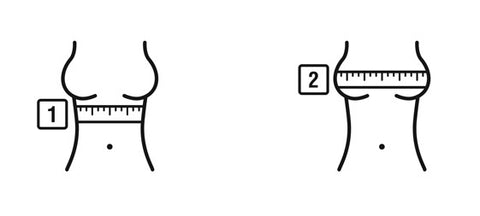
At-Home EZ-Fit Measurements
You can begin by measuring the ribcage.
Measure directly underneath the bust, wrapping around the ribcage. Round the measurement to the nearest even number to determine the band size. The band size is your ribcage measurement.
Next, we'll look at measuring the bust.
Hold the measuring tape parallel to the floor while measuring around the back, starting at the fullest part of the bust. Then, round to the nearest whole number to receive your bust size.
Finally, you can measure bra cup size at home using the bust measurement you just received.
Subtract your band size from your bust size, and that's your cup size.
The cup capacity is shown in inches.
AAA cup = 1/3 inch | AA cup = 1/2 inch | A cup = 1 inch | B cup = 2 inches | C cup = 3 inches | D cup = 4 inches | DD/E cup = 5 inches | DDD/F cup = 6 inches
The math behind how to convert bust size to cup size is Bust minus Band equals Cup.
Bra Size Chart: Quick Reference Examples
Here are some bra size examples for visual reference:
BAND 28 BUST 32 = 28D
BAND 30 BUST 35 = 30DD
BAND 32 BUST 36 = 32D
BAND 34 BUST 35 = 34A
BAND 36 BUST 39 = 36C
BAND 38 BUST 42 = 38D
BAND 28 BUST 34 = 28DDD/F
BAND 30 BUST 36 = 30DDD/F
BAND 30 BUST 32 = 30B
Prefer a full band-by-cup bra size chart, or want to skip the math entirely? Use BRABAR's online bra size calculator to plug in your two measurements and get your exact size instantly, or see the complete bra size chart by band and cup for every combination from 28 to 38.
Watch our video demonstration for how to measure your bra size at home with the EZ-fit method.
The Proper Fit
Does the size you received after measuring surprise you? Certain factors can cause your bra size to change, including a gain or loss in weight, a new exercise regimen, pregnancy, and a fluctuating diet. If you ever need to go down a cup size for a proper fit, you should go up one band size.
The bra brand could also slightly change the size you require. When this happens, a brand often provides a "sister size" to compensate as an alternative. Unfortunately, these sizes are often too large in the band area and too small in cup size, leading to unnecessary discomfort. However, through a bit of trial and error, you should be able to discover the size that works best for you. Contact us today with any questions you may have!
Telltale Signs You're Wearing the Wrong Bra Size
You can easily tell you're wearing an incorrect bra size through these telltale signs:
- Cups have visible wrinkling
- Underwire (for wired bras) is poking your breasts
- The band rides up
- Your bust is spilling out of the cup
- Straps are always slipping
- Your bra hikes up whenever you lift your arms
Do you find yourself with any of the above bra complications? If so, you can visit a bra fitter or use this guide to measure your bra size at home.
Frequently Asked Questions
What's the easiest way to find my correct bra size?
Measure your band (directly under the bust) and bust (fullest point) with a soft tape, then use BRABAR's online bra size calculator to convert those two numbers into your exact size instantly, without doing the subtraction yourself.
Is there a bra size chart I can just look up instead of measuring?
A chart can only ever be a general starting reference, since it can't account for your specific measurements. The most accurate approach is measuring your own band and bust, then using a calculator or chart to convert those two numbers into your size.
What's the difference between a bra size calculator and a bra size chart?
A calculator takes your exact measurements and computes your size directly. A chart shows pre-set combinations you compare your measurements against. Both use the same underlying math, a calculator is just faster and more precise for your specific numbers.
Do I need to add inches to my band measurement?
No. Measure the rib cage directly, with nothing added, then round to the nearest even number. Adding 4 or 5 inches is an outdated method that produces an inflated, less accurate band size.
Was this helpful? Star BRABAR on Google to catch every fit guide first.

