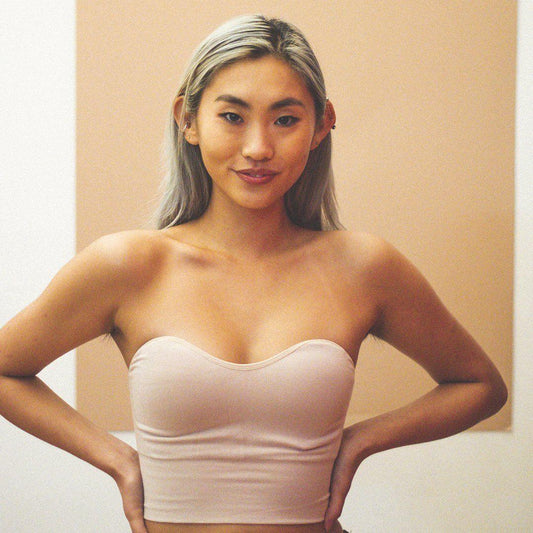

Ultimate Guide to Choosing Bras for Tween and Teen Bust Sizes
Choosing the right bra for a developing body can feel overwhelming. BRABAR makes the process easier with accurate, body-based measuring, comfortable wireless support and styles designed for teens and juniors ages 14–19.
Everybody develops differently. The goal is not to fit into a predetermined size or follow an outdated formula. It is to find a bra that fits the body comfortably and securely today.
Understanding Teen and Junior Bust Development
Breast development often begins between ages 8 and 13, but there is no single timeline that applies to everyone. Development typically starts with breast buds—small, sometimes tender bumps underneath the nipples—and continues gradually throughout puberty.
One breast may begin developing before the other, and natural asymmetry is common. Breasts may also change in size or shape during growth spurts and throughout the menstrual cycle.
The junior years, generally ages 14–19, are an important continuation of this development. A junior may have a more developed bust than a younger teen, but her rib cage, breast shape and proportions may still differ from those of a fully mature adult. She may also experience frequent size changes.
This is why BRABAR designs for developing bodies—not merely smaller versions of adult bodies.
Understanding Teen and Junior Bust Sizes
There is no standard bra size for a particular age. Two teens or juniors of the same age may have completely different bust sizes, and both may be developing normally.
A smaller-looking bust does not automatically mean an A cup. A teen with a small rib cage may wear a D or DD cup and still appear relatively small-busted because cup size is proportional to band size.
A cup letter cannot be understood without its band size. A D cup on a 28 band is not the same size as a D cup on a 36 band. The band and cup work together to describe the body's proportions.
What Is the Smallest Bra Size?
There is no universal smallest bra size because sizing systems and available ranges vary. Some bras begin with an A cup, while others include AA or AAA cups and smaller band sizes.
The smallest size offered by a particular collection is not the smallest possible body. It simply reflects the range that collection was designed to serve.
A teen should never be placed into a larger band because a smaller band is unavailable. If her rib cage measures close to 28 inches, beginning with a 32 band changes the relationship between the band and cup and may result in an inaccurate fit.
What Is a Training Bra?
The terms training bra and training bras are commonly used for first bras, but breasts do not need to be trained.
A training bra is simply a light-coverage first bra for someone beginning to develop. It is not a required stage, nor is there a point when a teen must “graduate” to a real bra.
Some teens prefer a soft pull-on bralette. Others ask for an “adult bra” when they simply mean a bra with adjustable straps and a back closure. A back-closure bra does not require an underwire or heavy padding.
The right first bra is determined by comfort, coverage and fit—not age.
Choosing a Bra for Teens and Juniors
The best bra for teens should reflect the wearer's development, activity and personal preferences. The same is true when choosing a teenage bra or a bra for a junior ages 14–19.
A well-designed teen or junior bra should:
- Fit securely around the rib cage
- Provide the desired coverage
- Support without relying on an underwire
- Stay in place during movement
- Avoid digging, rubbing, spilling or gaping
- Feel comfortable for extended wear
- Allow the wearer to feel confident in her clothing
Parents searching for a “teenager bra” are often looking for something between a basic first bralette and a traditional adult bra. A wireless bra with adjustable straps, thoughtfully constructed cups and a back closure can meet this need.
Types of Bras for Teenagers and Juniors
Different activities and outfits may require different styles. A useful collection of bras for teenagers and juniors may include the following.
Everyday bras
Comfortable everyday bras should feel secure enough for school, work and daily activities. A wireless back-closure bra can provide support, coverage and adjustability without the rigidity of an underwire.
Bralettes
Soft pull-on bralettes can work well during early development, for relaxing or whenever a teen wants light support and coverage.
Longline bra tops
Longline styles extend below the bust, providing additional coverage and a secure feel. They can work as bras, layering pieces or tops, depending on their design.
Sports bras
Sports bras help manage breast movement during physical activity. The appropriate level of support depends on the activity, the wearer's bust and her comfort preferences.
Convertible bras
Convertible or multiway bras provide flexibility for different necklines and outfits. Adjustable straps may be worn in several configurations.
Strapless bras
A strapless bra must be firmly anchored around the rib cage because it cannot rely on straps for stability. It should remain in place when the wearer raises her arms and moves.
Are Underwires Necessary?
Underwires are not necessary for support—even for fuller bust sizes.
The band is the foundation of the bra and provides most of its support. Cup construction, fabric, coverage and thoughtful design also influence how supportive a bra feels.
A correctly fitted wireless bra can support a developing teen or junior comfortably without adding a rigid wire underneath the breast tissue.
How to Measure for the Right Bra Size
BRABAR uses a body-based measuring methodology - the rib cage method, also known as our EZ-Fit shop-by-band-size philosophy. The band size begins with the actual rib-cage measurement, rounded to the nearest even number. Do not add four or five inches on top of it - that's the method used by calculators from brands like SKIMS and Aerie.
You will need a soft measuring tape and, if possible, a mirror to confirm that the tape stays level.
1. Measure the rib cage
Wrap the tape snugly around the rib cage directly underneath the breasts. Keep it level around the body. The tape should feel secure without being painfully tight.
Round this measurement to the nearest even number to determine the starting band size - for example, 28.5 inches rounds down to a 28 band, while 29 inches rounds up to a 30 band.
For example, if the rib cage measures approximately 28 inches, begin by trying a 28 band—not a 32 band created by adding four inches.
2. Measure the fullest bust
Wrap the tape around the fullest part of the bust. Keep it level and relaxed without compressing the breast tissue.
3. Estimate the starting cup size
Subtract the rib-cage measurement from the fullest-bust measurement:
- 1-inch difference: A cup
- 2-inch difference: B cup
- 3-inch difference: C cup
- 4-inch difference: D cup
- 5-inch difference: DD cup
- 6-inch difference: DDD/F cup
- 7-inch difference: G cup
For example, a 28-inch rib cage and a 33-inch fullest-bust measurement indicate a starting size of approximately 28DD—not 32A.
Measurements establish a starting point. Breast shape, bra construction, fabric and individual preference can influence the final fit.
How Should a Bra Fit?
A properly fitting bra should support a developing body comfortably and securely—without digging, gaping, slipping or restricting movement.
The band
The band should:
- Feel comfortably snug
- Sit level around the rib cage
- Remain in place when the arms are raised
- Fit on the loosest hook when the bra is new
- Provide most of the bra's support
If the band rides up the back or shifts during movement, it may be too large.
A helpful test is BRABAR's strapless-fit check. Lower the straps from the shoulders and see whether the bra remains securely anchored. If it does not, the band may be too loose.
The cups
The cups should contain the breast tissue without spilling, cutting in, wrinkling or leaving significant empty space.
After putting on the bra, gently position the breast tissue inside the cups. If there is spilling or pressure, try a larger cup. If there is significant gaping or wrinkling, try a smaller cup or a different style.
The straps
Straps should stay comfortably on the shoulders without slipping or digging. They should help stabilize the cups, but they should not carry most of the support.
Straps that continually fall may indicate that the band is too large, the straps need adjustment or the style does not suit the wearer's frame.
Common Bra-Fit Problems
The band rides up
The band is likely too large or has stretched out. Try a smaller band while adjusting the cup to preserve the correct cup capacity.
The straps dig into the shoulders
The straps may be overtightened to compensate for a loose band. Check the band before loosening or replacing the straps.
The cups spill at the top or sides
The cup may be too small, or the style may not accommodate the wearer's breast shape. Try a larger cup or another silhouette.
The cups gape
The cup may be too large, but gaping can also mean that the shape or construction is not right for the wearer. Try adjusting the straps before changing sizes.
The bra moves when the arms are raised
The band may be too large. A correctly fitted band should remain securely anchored around the rib cage.
The bra feels uncomfortable
A bra should not require a “break-in” period to become tolerable. Persistent pinching, rubbing or restriction means the size or style should be reconsidered.
Choosing Fabric and Construction
The comfort and performance of bras for teens depend on more than fiber content. Fabric, stretch, recovery and construction must work together.
Cotton
Cotton can feel soft and breathable. When blended with stretch fibers, it can also move comfortably with the body.
Nylon and microfiber
Nylon and microfiber can provide smoothness, durability, moisture management and shape retention.
Spandex or elastane
Stretch fibers help a bra adapt to movement and return to its original shape.
Lace
Soft lace can add texture and personal expression. Lace should feel comfortable against the skin and should not be assumed to make a bra less supportive.
The best fabric depends on the teen's sensitivity, activity and desired level of support.
Building a Teen and Junior Bra Wardrobe
A useful collection of teens bras should support different activities without becoming unnecessarily complicated.
Consider including:
- Two or three comfortable everyday bras
- Sports bras appropriate for regular activities
- A soft bralette or bra top
- A convertible or multiway style
- A strapless style when needed for specific outfits
- Neutral colors and expressive colors based on personal preference
Not every teen needs every style. The collection should reflect how she actually dresses and moves through her day.
When to Remeasure or Replace a Bra
Teen and junior bodies can change quickly. Remeasure after a growth spurt or whenever the bra stops feeling secure and comfortable.
A bra may need to be replaced when:
- The band rides up even on the tightest hook
- The elastic no longer recovers
- The cups spill or gape
- The straps repeatedly slip
- The bra shifts during movement
- The fabric, seams or closures are damaged
- The bra causes discomfort
- The wearer's measurements have changed
Rotating several bras and washing them carefully can help preserve their elasticity and shape.
Comfort, Support and Confidence
A bra should help a teen or junior feel comfortable and supported—not make her feel that her body needs to change.
Wearing the wrong size may cause rubbing, pressure or the need for constant adjustment, but a bra should not be presented as a way to control breast development or correct posture. Its job is to provide the desired support, coverage and comfort.
The most important part of choosing a teenage bra is listening to the wearer. Ask how it feels, whether she can move comfortably and whether she likes the coverage. Her experience matters more than assumptions about what someone her age should wear.
Choosing the Right Bras for Teens and Juniors
Finding the right bras for teens, juniors and developing bodies begins with accurate information. Measure the rib cage without adding inches, calculate the starting cup from the difference between the fullest bust and rib cage, and then evaluate how the complete bra fits.
BRABAR reimagines bras for the next generation by designing for the changing proportions and real needs of teens and juniors ages 14–19. Whether someone is choosing her first training bra, looking for comfortable everyday bras or moving into more supportive back-closure styles, the right bra should meet her body where it is today.
Comfort, support and confidence begin with a bra that fits the body—not an outdated formula.
Shop by Age & Find Your Fit
BRABAR designs for every stage of development, not a one-size-fits-all age bracket:
Not sure where to start? Use BRABAR's Fit Guide to find your exact size with the rib cage method.
Was this helpful? Star BRABAR on Google to catch every fit guide first.