
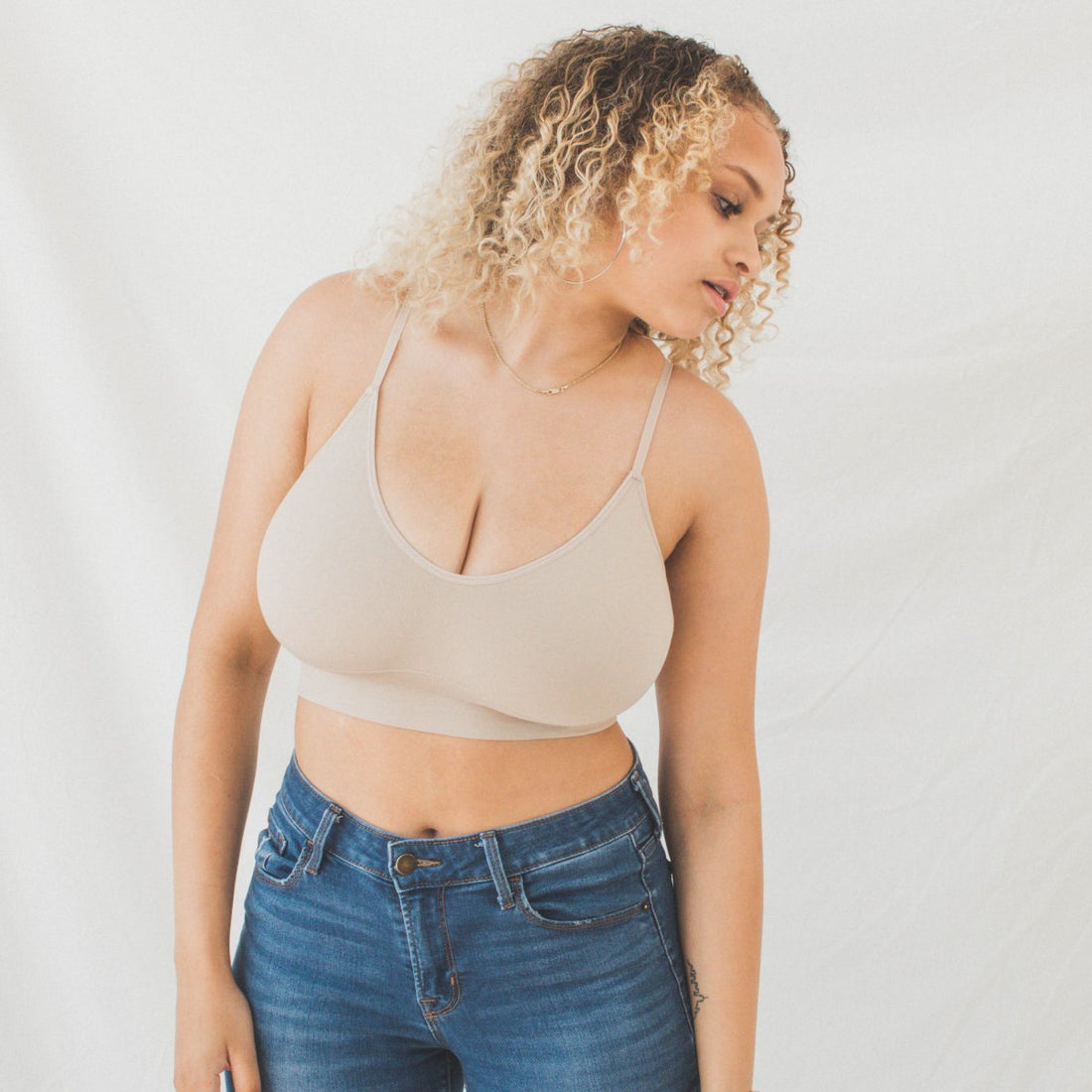
Plus 0, plus 4, and a whole lot more: Bra Sizing Simplified
I know I'm not the only one who has walked into a bra store and felt less confident than before the visit. The experience of bra shopping can be daunting. It's as if, in the span of only a few minutes, your bust goes from being a simple part of your body to a mathematical equation that defines your future shopping experiences. Unlike traditional clothing shopping, measurements are a crucial part of bra shopping, since they inform what level of support you need. So how come it seems that with each new bra shopping experience, you're led to a different conclusion?
Now I know what you might be thinking, because I've had that thought too — "I have a fuller bust, so I need a bigger bra"... not quite. Bra sizing is actually quite simple: two numbers, a little subtraction, a letter, and there you go. But if it's really that simple, why do most women end up wearing the wrong size bra?
Part of the answer traces back to bra-sizing conventions that predate the stretch fabrics we take for granted today. Early 20th-century bras, made of less flexible materials like satin and silk, left little room to breathe. To compensate, some manufacturers and fitting guides began adding a few inches to a woman's actual band measurement to provide a bit more give.
While stiff, non-stretch fabrics fell out of fashion decades ago, that old measuring habit didn't disappear as quickly — and the practice of adding inches still affects many women globally without them even realizing it.
You're probably thinking, I've been measured before, so how does this actually work? Stick with me, because it explains a lot.
Bra sizing begins with a base band measurement compared to the fullest bust measurement. The difference between the two determines your cup size. It's within these two measurements, though, that the real debate lives.
The rib cage method (sometimes called "plus zero") is the most accurate way to reach a correct bra measurement. Just as the name suggests, this method measures the underbust to the exact number of inches, then rounds to the nearest even number to get your band size. So if you measure 29 inches, you'd round to 30; if you measure 31, you'd round to 32. The plus-four method complicates this simple system, adding four (or five, for an odd-numbered measurement) inches on top of the direct measurement to reach a band size.
Don't worry if that sounds confusing — you're not the first person to wonder how the same body could produce two completely different measurements depending on the method. And that's exactly the issue.
The plus-four method may have made more sense in the era of stiff, non-stretch bras, but with the widespread use of elastic fabric today, women no longer need those extra inches for comfort or support. In other words, the method hasn't kept pace with the materials — and plenty of people have pushed back on it.
Much of that pushback has come from lingerie bloggers and fit advocates who've pointed out that being sized into a band that's several inches larger than your actual measurement isn't just inconvenient — it's a real barrier to finding a bra that actually supports you. Bra sizing shouldn't feel arbitrary, and no one should have to fight for an accurate starting point.
Part of the problem is a bit of a feedback loop: when a measuring method consistently produces an inaccurate size, and stores mostly stock bras built around that inaccurate size, it becomes harder for anyone to access their true size in the first place — particularly for people who need smaller bands.
I know this from personal experience. I spent years wearing a size 32 because that's what stores kept measuring me into, only to find the band would gape and the cups would sit oddly — despite not having a particularly petite frame to begin with.
All bodies are different and deserve accurate information, not an averaged-out guess. Bra sizing is part art, part science — and here at BRABAR, we build our sizing around the rib cage method for exactly that reason. So stick with us, and you'll never have to fear wearing the wrong size bra again!
XX,
BB
Was this helpful? Star BRABAR on Google to catch every fit guide first.